Pages

Tuesday, April 23, 2019

Hapuu, the Hawaiian Tree Fern, vs. the Australian Tree Fern


The Hawaiian tree fern is native to most of the Hawaiian Islands. Although once common, hapu’u stands have been reduced due to a large number of ferns being harvested for orchid media and landscape use. The last remaining large stands of native hapu’u are found on the Big Island.

The Hawaiian hapu’u  are very slow growing; the young ones grow at about 3.5 inches per year while the older plants grow even more slowly, eventually growing to  15-20 feet tall.  The unfurled fronds are covered with silky, red-brown wool-like fibers called pulu.  In the past, pulu was used for stuffing pillows and mattresses and for dressing wounds.


The Hawaiian tree ferns are relatively easy to grow. They grow best in well drained slightly acid soils and partial shade; they will tolerate full sun in cloudy upland areas. They need a steady supply of water and occasional light applications of a complete, slow release fertilizer. Old and injured fronds should be pruned. It is illegal to ship tree ferns or products from the ferns internationally. 


 The Australian tree fern, Cyathea cooperi, is considered invasive in the State of Hawaii due to aggressively out competing native plants in the forest understory. As a threat to  Hawaiian forests, this fern eventually displaces the native ferns, including the slower growing Hawaiian tree fern, or hapu’u.  


Although invasive, the Australian tree fern is being sold in Hawaii at many commercial plant nurseries. This fern grows to 40 feet tall and tolerates full sun in cool wet areas. The spores are spread by wind and can travel over 7 miles from the parent plant.

 The best diagnostic characteristic to distinguish between the Australian tree fern and the native hapu'u is the hairs on the leaf stems. With the  hapu’u, the hairs are either fine and reddish-brown for hapu'u pulu (Cibotium glaucum) or fine and black for hapu'u i'i (C. menziesii). The hairs on the Australian tree fern are broad and white.


                                                Cibotium menziessi

  Photos: Native Plants Hawaii, University of Hawaii


Saturday, February 2, 2019

Bugs - the Good, the Bad and the Ugly


Not all bugs in the garden are bad. 
Some bugs are beneficial. such as parasites and predators. The are looking for pests to consume. Two well-known good guys are preying mantis and lady bird beetles; spiders are also good predators.  Biological control can work very well. As an example, in California when certain species of whitefly came into a new area, both citrus  and some vegetable crops were damaged or completely destroyed. Yet within a number of years, their natural enemies were established, and for the most part, the pest became inconsequential.  Pollinating insect can also be categorized as beneficial.

Some bugs may be found on a plant, but are not feeding and therefore cause no damage. The bug may simply be resting or perhaps searching for nectar or another source of food.                                                                                                   
               
Some insects of course are known pests, but cause little damage. A bite may be taken from a leaf here and there,  or a little juice sucked from a stem, but overall, the plant is not harmed. 
On the other hand, some bugs do inflict damage, but it is only cosmetic. That is, the leaves or fruit may be scared or misshapen, but there is no real loss of yield.  In many cases, cosmetic damage should be tolerated. This type of damage on citrus fruit is caused by thrips and does not affect the internal quality.    
Above Photos: University of California IPM Program

And finally, if there is an infestation of an insect pest which will cause yields to be significantly lowered, the gardener will have to decide whether to wait a bit and see if biological control will work. If a parasite or predator can control the pest population, no intervention is needed. Yet if spraying is the choice, consider first a bio-rational pesticide, such as soap, oil, Bt or sulfur. These are less injurious to the environment, and may not harm the predator or parasite populations. 

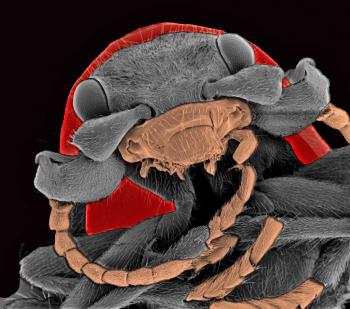
And, the Ugly
Colorized image of a flower beetle
Arizona State University


Wednesday, December 26, 2018

Poinsettias

This is the time of year many people have poinsettias. What to do with them after the holidays?

Care 
  • Poinsettia plants prefer indirect light, six hours daily is ideal.
    • Poinsettias require daytime temperatures of 60 to 70°F and night time temperatures around 55°F for best growth; high temperatures will shorten the life of the plant.

    • Standing water can be harmful for the plant. Remove any wrappings from around the pot or punch holes in the foil so water can drain into a saucer; discard excess water.  
    • In some climate zones poinsettias can be planted outdoors.
    Yet, some are concerned because they think the plants are poisonous. Are poinsettias poisonous? No, this myth has been around since the early 1900’s. The American Society of Florists has been trying to dispel the myth for a long time. They say that no other commercial plant has been tested for toxicity more than the poinsettia.

    According to the American Medical Association’s Handbook of Poisonous and Injurious Plants, ingestion of the poinsettia plant has been found to produce no ill effects except an occasional case of vomiting. According to the POISINDEX information source, a child who weighs 50 lbs. would have to consume over 500 leaves before he reaches a potentially toxic level. Since the taste of poinsettia leaves is reportedly unpleasant, it is unlikely that a child or animal who attempts to eat or chew the leaves, will continue to do so after the first taste. Some people, however, can develop a skin and eye irritation from contact with the milky sap of the plant.