Pages

Showing posts with label disease. Show all posts

Friday, October 7, 2022

Why Leaves Turn Yellow


When the leaves of a plant begin to turn yellow, determining the cause will take some investigation. There are several possibilities:

         The first consideration is a lack of nitrogen, especially if a number of plants are affected and there has been no recent application of fertilizer.  Apply a high nitrogen fertilizer, and if after a week or so the plants begin to turn green, the problem is solved.

          If the plants don’t turn green, the problem could be a disease.  Plants can become infected with a fungus, especially when over watered, causing a root or crown rot.  Inspect the roots and the crown of the trunk.  Scratch into the bark of the trunk at the soil line and also into a piece of root.  If the tissue inside is brown or black, rather than light colored, a root or crown rot is evident.     

         Another common reason for a general yellowing is a lack of oxygen in the root zone.  This is due to too much water – over irrigation or too much rain.  As long as the soil drains well the problem is minimized.  But in clay soils, water does not drain well, resulting in a waterlogged condition.  Without adequate oxygen in the soil, roots cannot function properly, and the plant turns yellow.  If the condition continues, root rot will develop and the plant will die.  That is why so many planting instructions suggest to plant in a well-drained soil. 

         If plants are yellow and lack vigor, a soil analysis can identify nutrient deficiencies and/or a pH imbalance.  The pH reveals the acidity or alkalinity of the soil. Most plants have a definite acid/alkaline range in which they will properly grow.

         Although not common, there is always the possibility of persistent chemicals in the soil.  A soil sterilant or preemergent herbicide may have been applied to the soil.  These compounds can persist for many years.  Preemergent herbicides are those that are sprayed on the bare ground and become incorporated into the top few inches of soil.  At label dosages they affect only the target weeds and last from several months to a year.  But if an overdose is applied, the chemical will be there for many years and adversely affect many plants. 
         An infestation of microscopic round worms called nematodes (example, root knot nematode) can also cause plants to yellow and be stunted.

Monday, June 29, 2020

The Plague of Powdery Mildew


Powdery mildew (PM) is a menace to many gardeners. The disease will turn large zucchini leaves white and later brown. A whitish cast will appear on many common garden plants such as tomatoes, beans, cucumbers, mustard, peas, and collards. Infected leaves often turn yellow to brown and may shrivel making the plant unproductive and eventually die.

The white fungal growth can develop both on the upper and the lower surfaces of the leaf, and sometimes, on flowers and fruit. The cottony like threads of this fungus travel along the surface of the leaf, occasionally sending “roots” down into the leaf tissue in order to obtain nutrients.

Many different types of powdery mildew fungi are host specific. This means that one particular mildew fungus will only infect those plants in a particular genus or family; the PM on the beans will not attack papaya, and the PM on mangoes will not attack tomatoes. 

The fungus likes temperatures between 60 and 80 degrees F being sensitive to temperatures above 90. Cool days and warm nights favor the disease. Spores of the pathogen are dispersed readily by wind. Even though this disease flourishes with high humidity, wet leaves can actually inhibit germination of the fungal spores, thus preventing infection. Because of this, the disease should be minimized during periods of heavy rainfall. Also during this time, the numerous spores that are on the leaves will be washed away.

Control Stopping powdery mildew in its earliest stages of development provides the best control. This can be done by sanitation: remove and destroy infected parts of the plant. Other measures of control are as follows: plant in the sunniest locations, provide good air circulation through pruning, and avoid excessive applications of fertilizer.

Fortunately there are a number of relatively safe and effective materials to use against this fungus - wettable sulfur, horticultural oils, including neem, and Kaligreen (potassium bicarbonate a relative of baking soda). Serenade is a biological fungicide, a bacterium, that helps prevent the powdery mildew from infecting the plant. Cucurbits (melon, squash, cucumbers) can be sensitive to sulfur.  Do not apply when the temperature is near or over 90 degrees and do not apply within 2 weeks of an oil spray. Use these materials in the earliest stages of disease development for best results.  Before spraying, it would help to remove the leaves that are heavily infested.  Do not dispose of them on the ground since they are loaded with fungal spores. Powdery mildews can attack healthy plants; but older plants, less vigorous plants and those that are stressed are more susceptible to infection.  


Most important, choose plant varieties (vegetables, fruit trees and ornamentals) which are tolerant or resistant to the powdery mildew fungus. For more information about seeds from locally developed vegetable varieties, contact the University of Hawai‘i at Manoa: http://www.ctahr.hawaii.edu/seed/seeds.asp. Or, contact your local university cooperative extension office. Note: Some of the resistant varieties will exhibit powdery mildew symptoms, but the disease is less severe. 

Photos: Cornell University, Colorado State University and USDA

Wednesday, December 4, 2019

Citrus Scab Disease


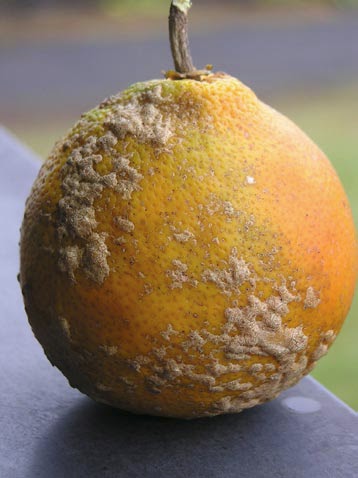
What causes the scabby bumps on citrus fruit? This disorder, common in high rainfall areas, is called citrus scab. The disease occurs in Hawaii, as well as in Florida, but not in California due to the dry climate. It is caused by a fungus, Elsinoe fawcetti, and affects a wide range of citrus.

                                                       
The light brown, raised, warty scabs appear on young stems, leaves and fruit.  Leaves develop some resistance to citrus scab with age. The scabs consist of the body of the fungus plus the swollen tissue of the host plant.

Spores are produced within these scabs and will spread to other tissues by the splashing rain or irrigation water. Infection occurs when the spores germinate on a susceptible plant surface that remains wet for approximately 3 to 4 hours.


Control 
·        Select a resistant species or variety. 
·        Plant in a sunny and dry location as is available.
·        Intercrop citrus with non-citrus plants or resistant citrus trees.

Citrus scab can reduce yield and will certainly reduce the quality of the fruit. For home production, as bad as it looks, the fruit can still be sweet and juicy. For those caring about the external appearance of the fruit, trees can be sprayed with a copper fungicide. Yet even numerous applications may not be effective in high rainfall areas.

Highly susceptible citrus types: Fremont, Clementine, Murcott and Frost Satsuma mandarins; Orland Tangelo; Tahitian lime and Rangpur lime, often referred to as the common lemon in Hawaii.

Not susceptible or immune citrus types: Sweet orange, navel orange, pummelo and grapefruit.

Wednesday, April 5, 2017

Nematodes


 Nematodes are microscopic roundworms. There are both good and bad nematodes. Many nematodes live in our soils and are beneficial.  But there are a number of harmful species that attack plants. These nematodes insert their stylet mouth-part, much like a  hypodermic needle, into the  tissue and suck out the plant juices.  

Plants which are infested with nematodes may exhibit symptoms of stunting, yellowing and wilting. Further symptoms may be smaller and fewer leaves, and smaller fruit.  Also, due to this feeding, the root knot nematode, in particular, will cause the plant cells to rapidly enlarge, thus developing characteristic bumps or knots on the roots. 


What to do?  If root knot nematodes are in your garden, take it seriously. Eradicating the garden of nematode pests is highly unlikely, but they can be managed with good sanitary procedures. Here are some measures:
·      Apply organic matter (OM) to the soil.  OM will encourage the growth of beneficial organisms, fungi, bacteria and good nematodes. They, in turn, will ‘attack’ the plant parasitic nematodes and deplete their numbers. A note of interest, there is one species of fungus that forms loops with its fungal threads. Nematodes will become stuck in these loops, which will actually tighten, and eventually the nematode dies. 

·      Crop rotation  Do not replant the same crop or any susceptible crop into infested soil.  For instance, if you discover root knot nematodes on your cucumbers, plant a resistant crop, like garlic or corn, in place of the cucumbers. For best results, do not plant with a susceptible crop for 3 years.

·      Keep the soil fallow. A more drastic form of crop rotation is simply keeping the infested area fallow. This starves the nematodes. Do not allow any crop, even weeds to grow there. But do add organic matter. Again, 3 years is best.

·      Soil sterilization  This involves covering the infested area with a piece of clear plastic for at least one month and preferably two. This should be done during the hottest part of the year.  In hot climates with clear skies, enough heat can be produced underneath this tarp to kill most of the nematodes. 

·      Plan resistant varieties. The best control against nematodes is to use resistant varieties. You may notice on a tomato seed package the letters VFN.  This means that the variety is resistant to the fungus, Verticillium and Fusarium and to the root knot nematode.  Such varieties include Celebrity and Better Boy. Asparagus, corn, garlic, onion, strawberry, zinnia, salvia and marigolds are also resistant to root knot nematode.  

Most Important: DO NOT SPREAD CONTAMINATED SOIL
Perhaps the most important aspect of controlling nematodes is to stop them from spreading throughout the garden.  If your tomato patch is newly infested with nematodes, keep those nematodes there. Nematodes will slowly spread in the soil by themselves. Don’t help them by carrying soil from the infested area to other areas, or by carrying around contaminated dirt clinging to garden tools and shoes. Work in an infested area last. Always clean tools and shoes.  Be cautious when receiving potted plants from other gardens or even from a nursery that has non-sterilized soil.    

Marigolds have been reported for many years as a way of reducing the nemotode populations. The French marigolds are most effective; varieties include Nemagold, Petite Blanc, Queen Sophia, and Tangerine. Unfortunately, planting a few marigolds next to each susceptible plant will NOT eliminate the problem. To be effective, the entire infested area needs to be planted in marigolds, each plant about 7 inches apart. The flowers must be planted for a minimum of two months and then turned under. The area also needs to be kept free of weeds. Then, root knot sensitive plants can be planted back into that area the following planting season. Replanting marigolds every other year will almost certainly be necessary.