
A common pest that infects indoor
and outdoor palms is the coconut mealybug (Nipaecoccus nipae).
They are soft-bodied insects that suck sap from plants. This can weaken the plant and cause leaves
to shed. In addition to palms, coleus, lantana, hoya,
and poinsettia are preferred by the mealybug.
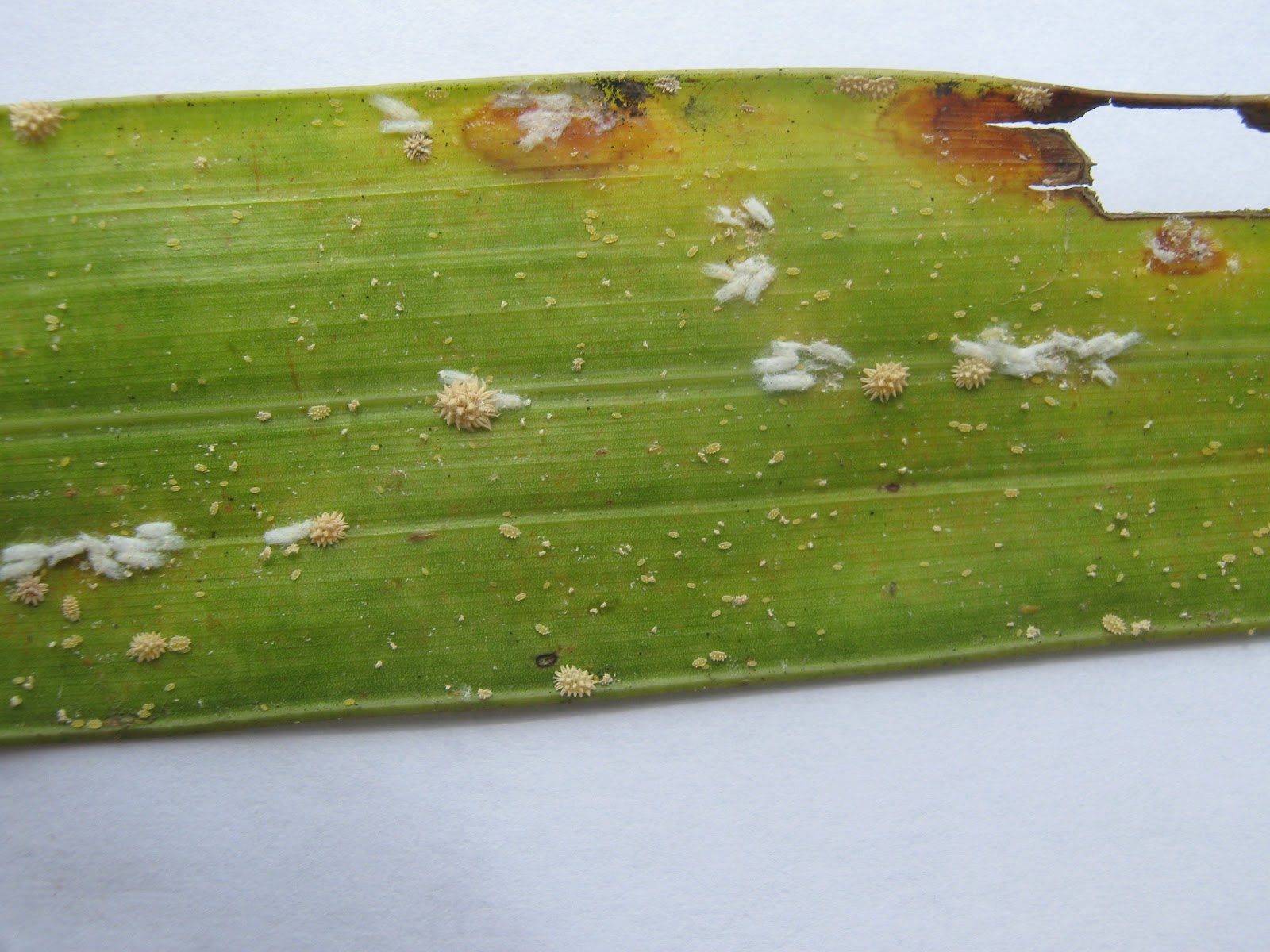 
Some coconut mealybugs are white in
color; others range from light brown to yellowish orange. When the eggs hatch, the newly emerged
insects, known as crawlers, move about the plant. At this stage they are the most
susceptible to pesticides, and therefore, it is the best time to treat. Pyrethroid insecticides and insecticidal
soaps are usually quite effective. Spraying the insects
off the plant with a strong spray of water will also help. For light
infestations, wipe the leaves with a cloth or tissue dipped in rubbing alcohol.
|
Tuesday, July 24, 2012
Coconut Mealybug

Friday, July 13, 2012
Cuban Laural Thrips – Attack on Ficus!

Cuban Laural
Thrips are fairly easy to identify; the damage is quite distinguishable. They attack only a few species of Ficus,
notably the retusa, while most others are immune. But when thrips become abundant, they will
feed on other hosts.
Using their
rasping, sucking mouthparts, they feed on the tender, light green leaves
causing a sunken purplish red spotting.
As the thrips feed, the individual leaves roll together with the thrips
inside. Eventually, the feeding causes a
yellowing of the leaf along with some dark spotting. In the wind and rain these
leaves will ultimately drop off.
With small
trees, regular pruning of infested branches is often effective. Shearing off a
few inches like trimming a hedge, however, should be avoided. This will
stimulate new growth which is then susceptible to attack.

Folded
leaves can be unsightly but rarely become serious. In most cases the thrips can be ignored. If treatment is needed, common contact
insecticides are of little use since the thrips are rolled up inside the
leaf. Using a systemic insecticide like acephate (Orthene) would be more
effective.
Tuesday, July 10, 2012
Spinach by Any Other Name?
New Zealand spinach, (Tetragonia tetragonioides) as its name implies, is indigenous to New Zealand, but it is not spinach at all. Not only does it look different from our regular spinach, the two are not even in the same plant family. However, some will tell you that NZ spinach tastes better. It can be eaten fresh in salads or steamed and is especially good sautéed in olive oil and garlic.
The advantage in planting this species is that it grows in hot weather (up to 95° F) and will not bolt. Bolting is the premature flower formation initiated by hormones within the plant system in response to high temperatures, as well as drought and starvation. This unwelcome occurrence in leafy plants such as cabbage, lettuce and spinach, takes the plant out of its leaf producing mode and switches over to flower and seed production. The fact that NZ spinach is resistant to bolting makes it ideal for growing in tropical climates.
In regions with mild winters, this spinach acts like a perennial with frequent picking stimulating new growth. The plant will reach a height of 1-2 feet, spreading to 2-3 feet across. The seeds are large and germinate slowly. Soaking for 24 hours before planting will help germination. Rows need to be 24-30 inches apart, plants 12-15 inches apart. The first foliage is ready for harvest about 2 months after seeding.
NZ spinach is low in saturated fat and cholesterol. It is a good source of many vitamins and minerals: thiamin, niacin, foliate, pantothenic acid, phosphorus, potassium, zinc and a very good source of vitamin A, vitamin C, riboflavin, vitamin B6, calcium, iron, magnesium, copper and manganese.
Malabar spinach (Basella alba, B. ruba) is yet another spinach substitute, unrelated to the New Zealand spinach. It is also known as Ceylon spinach and Vietnamese spinach. This is the one that has the mucilaginous texture (it’s slimy) and is useful as a thickener in soups and stews.
It is a fast growing vine which tolerates high rainfall. It grows best when trellised and is well adapted to high temperatures, even into the 90s F. But growth is disappointing when temperatures stay below 80 F. The plant requires consistent moisture to keep it from flowering, which will cause bitterness in the leaves.
The advantage in planting this species is that it grows in hot weather (up to 95° F) and will not bolt. Bolting is the premature flower formation initiated by hormones within the plant system in response to high temperatures, as well as drought and starvation. This unwelcome occurrence in leafy plants such as cabbage, lettuce and spinach, takes the plant out of its leaf producing mode and switches over to flower and seed production. The fact that NZ spinach is resistant to bolting makes it ideal for growing in tropical climates.
In regions with mild winters, this spinach acts like a perennial with frequent picking stimulating new growth. The plant will reach a height of 1-2 feet, spreading to 2-3 feet across. The seeds are large and germinate slowly. Soaking for 24 hours before planting will help germination. Rows need to be 24-30 inches apart, plants 12-15 inches apart. The first foliage is ready for harvest about 2 months after seeding.
NZ spinach is low in saturated fat and cholesterol. It is a good source of many vitamins and minerals: thiamin, niacin, foliate, pantothenic acid, phosphorus, potassium, zinc and a very good source of vitamin A, vitamin C, riboflavin, vitamin B6, calcium, iron, magnesium, copper and manganese.
Malabar spinach (Basella alba, B. ruba) is yet another spinach substitute, unrelated to the New Zealand spinach. It is also known as Ceylon spinach and Vietnamese spinach. This is the one that has the mucilaginous texture (it’s slimy) and is useful as a thickener in soups and stews.
It is a fast growing vine which tolerates high rainfall. It grows best when trellised and is well adapted to high temperatures, even into the 90s F. But growth is disappointing when temperatures stay below 80 F. The plant requires consistent moisture to keep it from flowering, which will cause bitterness in the leaves.
Subscribe to:
Posts (Atom)